In architecture, construction, and technical project delivery, BIM is no longer an unfamiliar concept. Many professionals see it as a major step forward that helps projects become better organized, improves coordination, and reduces conflicts from the early stages.
However, there is still one common misconception:
Once you start building a BIM model, the project will automatically become more structured and efficient.
In reality, it is not that simple.
A BIM model only delivers real value when the team has clearly defined its objectives, scope, and coordination approach from the very beginning. Without that clarity, the model may still look impressive and highly detailed, but it can lack practical usefulness, fail to connect different disciplines effectively, and even create more revisions later on.
So before starting BIM modeling for a project, what exactly needs to be clarified?
At CMC Architects, BIM does not begin with software. It begins with the right questions. Because only when the right questions are asked at the start can a project move in the right direction afterward.
Below are 7 key questions to settle before building a BIM model for a project so your team can work more clearly, coordinate more effectively, and avoid many unnecessary issues along the way.
1. What is the BIM model being built for?

This is the first question, and also one of the most commonly overlooked.
It sounds simple, but if the purpose of BIM is not clearly defined, the team can easily fall into a reactive workflow: some parts become overly detailed, others remain too basic, and every discipline contributes without knowing exactly what the model is meant to support.
A BIM model can serve many different purposes, such as:
- Supporting concept design
- Detecting clashes between disciplines
- Developing technical documentation
- Assisting quantity takeoff
- Coordinating construction
- Supporting facility operation and management later on
Each goal leads to different requirements in terms of model detail, data structure, and organization.
If the objective is unclear, the model can easily become a large block of data that does not truly serve anyone well.
Are you building BIM for presentation, coordination, or construction? Once this question is answered clearly, many of the decisions that follow become much easier.
2. How far should the BIM scope go?
Not every project needs BIM for every component. And more work does not always mean better results.
One common mistake is starting the model without defining the scope clearly. The result is that the team spends too much time on areas that are not essential, while critical zones may not receive the attention they actually need.
Before implementation, the following should be clarified:
- Is BIM being developed for the entire project or only part of it?
- Which disciplines are included?
- Does it cover architecture, structure, and MEP, or only one specific package?
- Which areas should be prioritized for modeling first?
Once the scope is clearly defined, resources can be allocated more effectively, progress becomes easier to control, and the team avoids spreading itself too thin.
At CMC Architects, an effective BIM model is not about modeling everything. It is about identifying the right parts to model in order to create the highest value for the project.
3. What level of detail does the model actually need?

This is an extremely important question because it directly affects time, cost, and how effectively the model can be used.
Many projects make the mistake of building the model with too much detail too early. That often leads to heavy files, difficult revisions, and a large amount of effort without proportional value. On the other hand, some projects are modeled too loosely, leaving the model with insufficient data for proper coordination.
That is why, before starting BIM, the team should define:
- What level of detail is appropriate for the current stage?
- Does the model need to support space checking, clash detection, or construction execution?
- Which data is essential now, and which information can be added later?
When this is answered properly, the team can avoid two common extremes: doing too much or not doing enough.
A good BIM model is not the one with the most detail. It is the one with the right level of detail for the project’s actual objectives.
4. Who will use the BIM model after it is built?
Many BIM models are completed but later underutilized simply because no one clearly defined who the end users would be from the start.
This is a highly practical question, yet it is often underestimated.
A BIM model may be used by:
- Architects
- Structural engineers
- MEP engineers
- Documentation teams
- Construction teams
- Project owners
- Facility management units
Each user group requires a different approach. Some need the model for technical review. Others need data extraction. Some need better visualization to make decisions more quickly.
When the main users are clearly identified, the team can organize the information better, prioritize the right data, and present the model in a way that is easier to use.
Think about it this way: if a model is built with great effort, but the next person cannot quickly read it or use it immediately, is it truly an effective model?
5. What coordination standards will govern the disciplines?

A BIM model cannot deliver its full value if each discipline works in a different way.
That is why, before modeling begins, the project needs to establish clear coordination principles such as:
- File, view, family, and sheet naming conventions
- Grids, levels, and reference points
- Rules for layers, categories, and worksets
- How the model is divided among disciplines
- How versions are checked and updated
These may sound like small technical details, but in reality, such details determine how smoothly the entire coordination process runs.
At CMC Architects, standards are not there to make the work more complicated. They are there to help teams move faster, understand one another more easily, and reduce repeated errors throughout the project lifecycle.
Without a unified coordination framework, BIM can quickly turn into a collection of disconnected models rather than one integrated working system.
6. Is the input data clean and clear enough?
This is another critical question, yet it is often overlooked because many teams are too eager to start modeling right away.
In practice, BIM can never be stronger than the quality of its input data. If the original information is incomplete, inconsistent, or fragmented, the model built from it will inevitably face the same issues.
Before starting, the team should review:
- Are the CAD files consistent?
- Do plans, elevations, and sections match?
- Are dimensions, levels, and grid references clear?
- Is the information from other disciplines sufficient for coordination?
- Which areas are still missing data and need clarification first?
Starting BIM with unclear data is like building on an unprepared foundation. The further you go, the more revisions tend to appear.
CMC Architects always treats input-data review as the foundation of the BIM process. Only when the input is clear can the model develop in the right direction and reduce risks in later stages.
7. What are the timeline, delivery milestones, and change-control process?

BIM is not only about the model itself. It is also about schedule management and change control.
Before modeling begins, the project should define:
- The timeline for each modeling stage
- Internal and client-facing delivery milestones
- How changes will be updated during the workflow
- Who is responsible for approving adjustments
- What process will be followed when conflicts or revisions arise from stakeholders
Without a proper change-control mechanism, the model can easily become tangled in overlapping updates, with each discipline holding a different version and no one being sure which one is the latest.
A strong BIM process always goes hand in hand with a clear change-management system. That is how the model is not only built correctly, but also maintained correctly throughout the project.
Effective BIM Starts with the Right Questions
Many people think BIM is mainly about technology. In reality, BIM is first and foremost about project organization thinking.
Software is only a tool.
The model is only the outcome.
The real quality lies in how the project is prepared from the beginning.
These seven questions do more than help teams avoid mistakes when starting BIM modeling. They also create a stronger coordination foundation across disciplines, between design and execution, and between ideas and real construction.
At CMC Architects, BIM is not treated as a trend to follow for appearance’s sake. It is approached as a working method that must be defined correctly from the start, so every piece of data created serves the project’s true purpose.
Before Building BIM, Clarify First to Move Faster Later
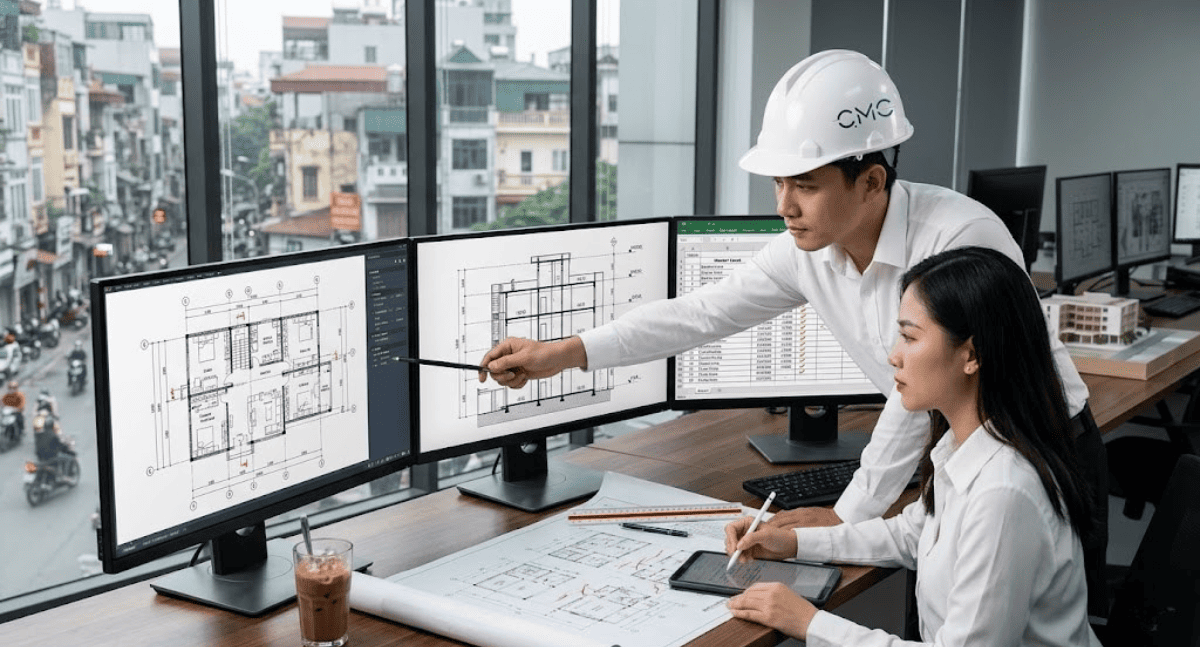
In any project, moving fast does not always mean working effectively. But getting clarity from the beginning almost always makes the rest of the process much lighter.
If you are preparing to implement BIM for a project and want to avoid the common cycle of building first and fixing later, this is the right moment to settle the key questions carefully from the start.
Has your project clearly defined the purpose of BIM yet?
Is your input data clear enough to begin modeling?
Does your team already have a coordination standard that is structured enough to support the process?
If you are looking for a partner to help organize data, standardize inputs, and implement BIM in a practical, structured, and effective way, CMC Architects is ready to help you build a strong foundation from the very first step.