Balustrades and staircases are items that are touched every day: going up and down, gripping surfaces, cleaning, and constantly visible. Therefore, even a slight deterioration can instantly make the entire house look less elegant.
It's worth noting that many buildings suffer from rust, looseness, creaking, peeling paint, and stains not because of poor quality materials, but because of a small detail overlooked from the start.
What are those details?
👉 How to handle the "contact points" between the railing/staircase and the floor/wall (especially the baseboards, mounting plates, drainage holes, and moisture barrier).
Simply put: water and moisture enter from here.
This article will help you understand why a small detail determines lifespan, and how to properly maintain your railings and staircases so they last 10-20 years while still looking brand new
Why do railings and staircases deteriorate so quickly?
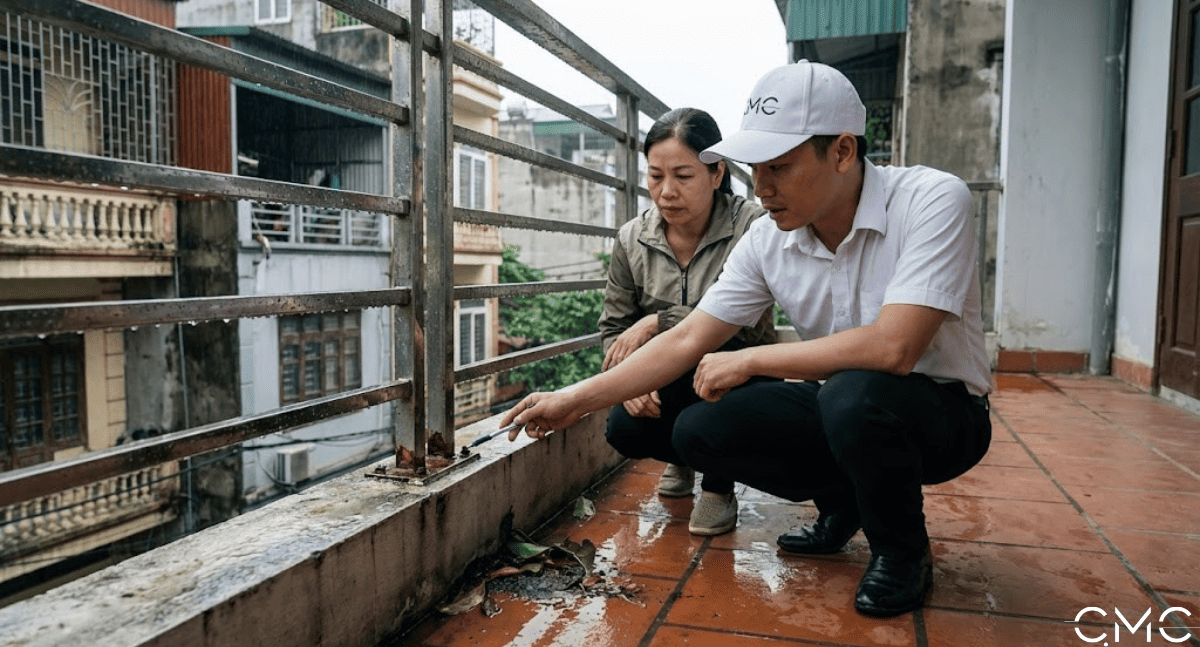
There are four biggest "enemies":
1. Water & moisture (especially in balconies, terraces, bathrooms, and near windows)
2. Vibration – impact force (handrails are where users exert force every day)
3. Material expansion (heat and cold cause metal to expand and contract)
4. Incorrect construction details (looks good on the outside but the fault lies in the "hidden" part)
Of these, water/humidity is the most common cause:
- Stainless steel is stained and tarnished.
- Steel rusts from the inside out.
- Paint on the support posts is peeling and blistering.
- Welds are pitted and gradually deteriorate over time.
- Handrail vibrates, bolts are loose.
What kind of problems are you experiencing at home: rust, vibrations, or stubborn stains? Comment below so I can suggest the right solutions
"Small details" determine lifespan: The support legs and anchor points must be properly waterproofed
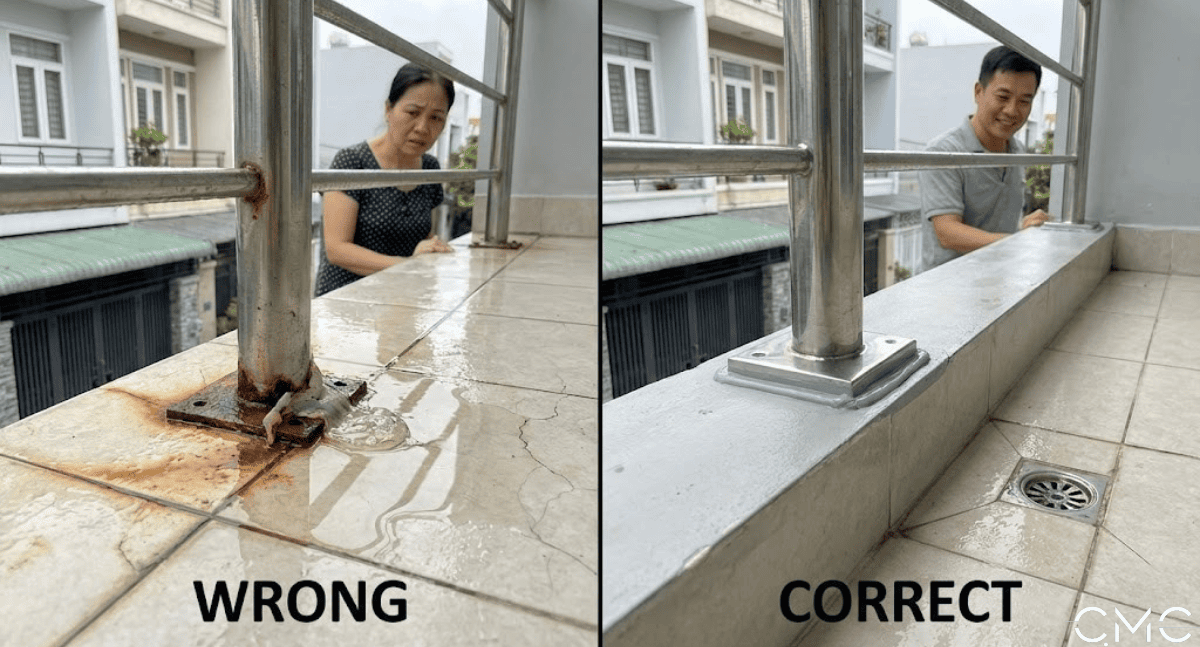
1) Don't let the support legs get damp
Common mistakes:
- Drilling and attaching support posts directly to the balcony/terrace floor
- No waterproofing layer, no proper sealant
- Rainwater seeps through the drilled holes → rust from the inside out
✅ The correct way to do it:
- Remove water from the base of the support post using waterproofing treatment and specialized sealant.
- Prioritize designing the support post with a base and a tight seal around the base.
- For outdoor areas: consider raised support posts to avoid direct contact with standing water.
It may look like "just a ring of sealant," but in reality, it's the "gateway" that determines how long the railing will last.
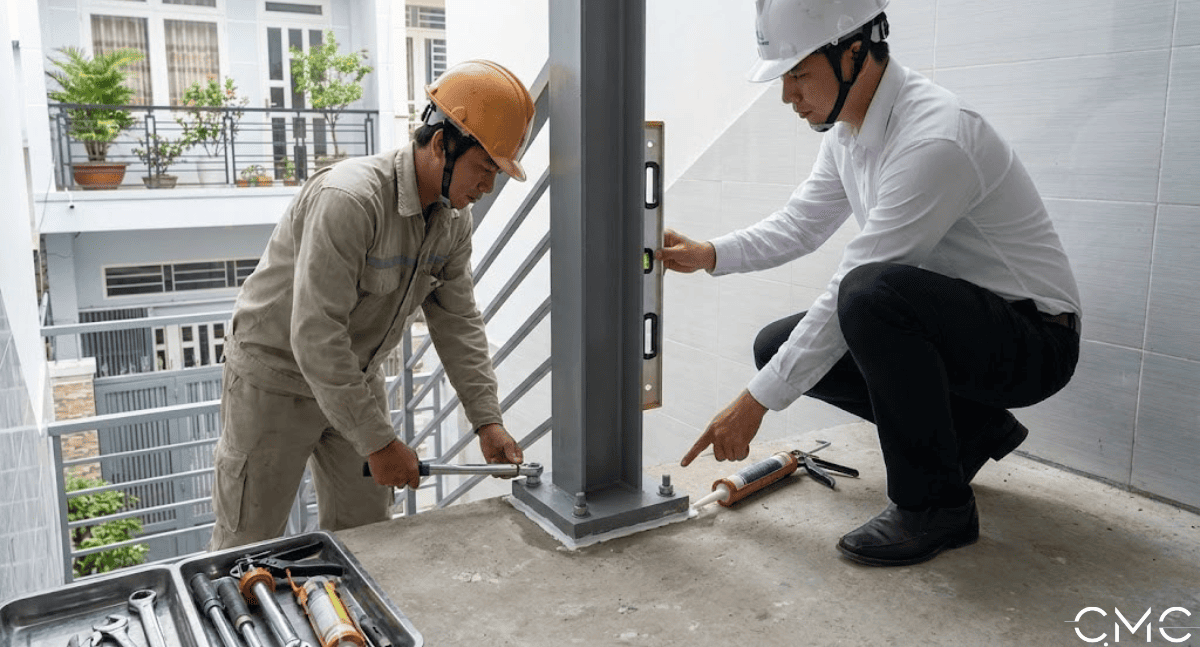
2) Base plate – bolts: Only "correct technique" will eliminate vibration
Shaking railings/staircases are often caused by:
- Thin base plate
- Few/small bolts
- Anchored to a weak wall (hollow brick wall, unreinforced)
- Too far between posts
✅ The correct way to do it:
- The base plate is thick enough and has sufficient support area.
- Anchoring is done correctly in the structural position (beam/slab), avoiding anchoring to the finishing layer.
- The spacing of the posts is calculated correctly to ensure the handrail is secure.
- Vibration resistance testing is performed before handover.
👉 Do you prefer glass, wrought iron, or stainless steel railings? Each type has different "weaknesses," and I can point out the specific ones to consider
3) Drainage holes & floor slope: no water accumulation = long-lasting durability
Many houses have beautiful railings, but what about the balcony/terrace flooring
- Incorrect slope
- Slow drainage
- or water accumulation at the base of the pillars
✅ The correct way to do it:
- Ensure proper drainage slope and catch basin.
- Avoid placing the support posts directly in "water accumulation areas".
- If possible: position the support posts away from areas where water collects.
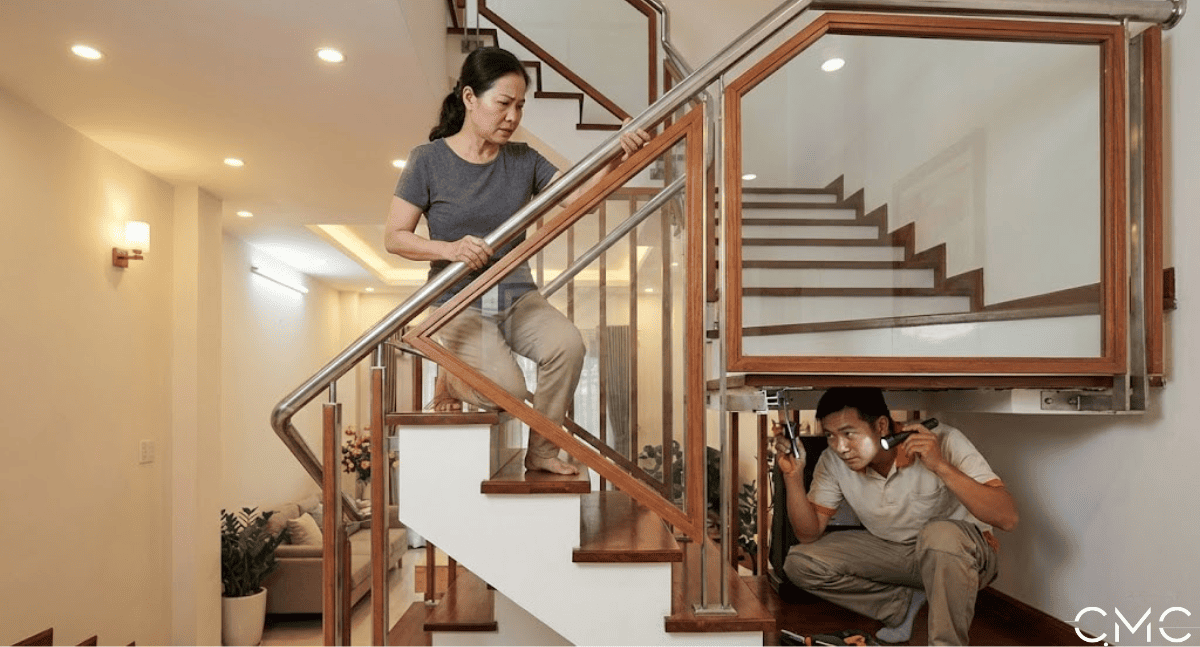
The staircase inside the house also has similar "small details"
When it comes to stairs, the weaknesses often lie in:
- Handrail joints (curved joints, corners)
- Hidden welds/bolts → cannot be inspected
- Support posts attached to wood/stone floors but without proper vibration damping/sealant
✅ The correct way to do it:
- Prioritize connections that are easy to inspect and maintain.
- Choose handrails that are comfortable to hold, sturdy, and not "thin and beautiful but weak."
- Select suitable finishing materials: wood must be treated to resist moisture, and stone must be non-slip.
5 warning signs that your rail/staircase is "losing its lifespan"
If you notice any of these signs, you should get checked out soon:
- The support posts have yellow/reddish-brown stains (rust marks).
- The handrails vibrate when gripped firmly.
- There is a creaking sound when going up and down.
- The welds have pits/rust spots.
- The sealant around the support posts is cracked or peeling.
Which symptoms are you experiencing? Comment with numbers 1–5 so I can suggest a course of action
A practical example to understand: "The difference between good and bad glue is between glue that lasts 2 years and glue that lasts 10 years."
- Project A: Outdoor foundation posts are directly attached with standard silicone sealant → Rust and paint peel off after 1-2 rainy seasons.
- Project B: Foundation posts are waterproofed with standard outdoor sealant and have good drainage → Remains stable for 8-10 years, only requiring periodic cleaning.
The difference isn't about whether the railing is "expensive or cheap."
The difference lies in the waterproofing detail at the base of the posts.
How to make your railings/staircases both beautiful and durable? (Short checklist)
✅ Before construction begins:
✅ During construction:
✅ After use:
CMC Architects: Beauty is one thing, durability is what makes it "worth the money"
At CMC Architects, we always consider railings/staircases to meet three criteria:
Safety – Durability – Aesthetics (in that order of priority).
If you are planning to construct or renovate a railing/staircase, CMC can assist you:
📩 Comment “BALUSTRADES” or “STAIRCASE” + the type you want (glass/iron/stainless steel/wood) so CMC can suggest the most durable option.
Questions for you to interact with (I will answer each comment)
If you had to choose one most important criterion for railings/staircases, you would choose:
Comment 1/2/3/4 — I will suggest the solution that best suits your priority
- 📞 Hotline: 0936361299
- 📧 Email: cmc.vn1013@gmail.com
- 🌐 Website: https://cmcarchitects.com/
- 📍 Address: 79A Xuan La, Tay Ho, Hanoi