In a production drawing package, dimensions are extremely important. However, dimensions alone are not enough. For steelwork items such as steel railings, steel staircases, handrails, technical ladders, steel door frames, louvers, panels, base plates, bolts, and connection details, technical notes play an equally important role.
Technical notes help the fabrication workshop clearly understand the required materials, fabrication method, connection details, surface finish requirements, tolerances, inspection standards, and special instructions before the drawing is applied in actual production.
A drawing may look visually clear, but if it lacks proper technical notes, readers may misunderstand the design intent, fabricate incorrectly, or need to ask repeated questions. On the other hand, a drawing with clear technical notes helps the production, inspection, and installation process proceed more smoothly.
So why are clear technical notes essential on steelwork production drawings? Let’s explore this topic in detail with CMC Architects Vietnam.
1. What Are Technical Notes on Production Drawings?
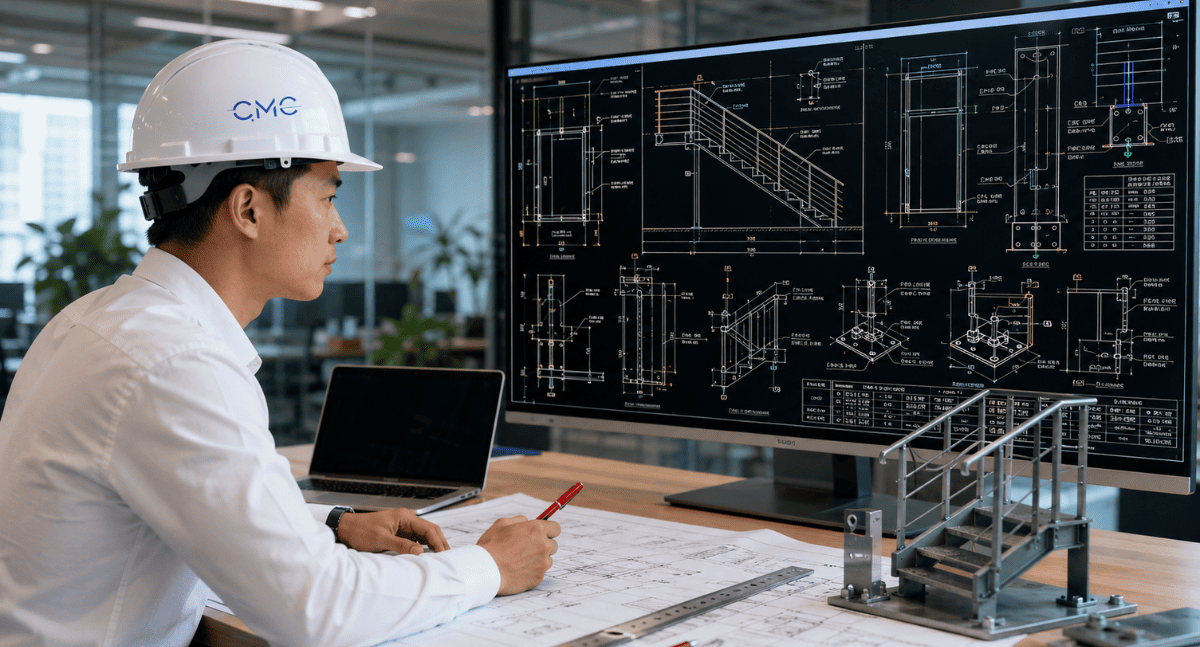
Technical notes are additional information shown on drawings to explain details that cannot be fully communicated through lines, shapes, and dimensions alone.
In steelwork production drawings, technical notes often relate to:
- Material type.
- Steel specifications.
- Material thickness.
- Fabrication methods.
- Welding details.
- Bolt details.
- Base plate dimensions.
- Drilling requirements.
- Surface treatment methods.
- Paint, galvanizing, stainless steel, or special finishes.
- Fabrication tolerances.
- Inspection requirements before handover.
- Notes for transportation and installation.
In simple terms, if the drawing is the “visual language,” technical notes are the explanation that helps the fabrication workshop and installation team correctly understand the design intent.
2. Why Do Steelwork Production Drawings Need Clear Technical Notes?
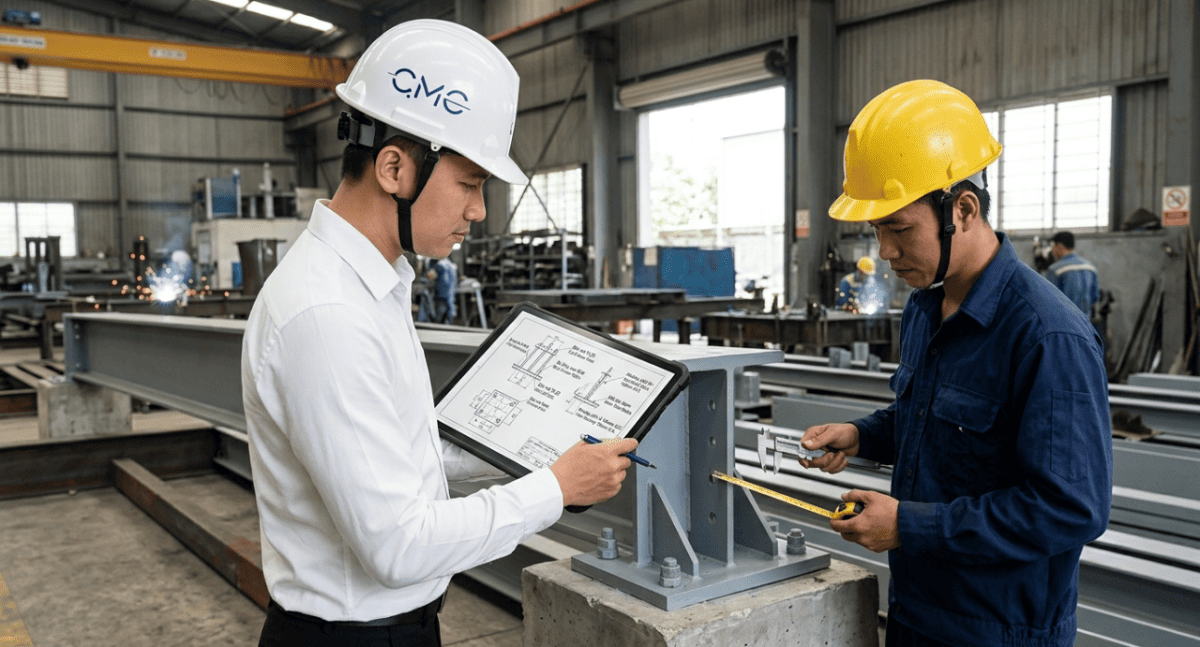
Steelwork items are usually fabricated based on drawings before being delivered to the construction site for installation. Therefore, if the drawing information is unclear, errors can occur right from the fabrication stage.
A small detail such as the wrong steel thickness, incorrect bolt hole position, missing paint note, or unclear welding method can affect the entire fabrication and installation process.
Clear technical notes help:
- The fabrication workshop understand the requirements correctly.
- The quality control team have a clear basis for inspection.
- The installation team follow the correct method.
- Reduce repeated questions during production.
- Minimize fabrication errors.
- Reduce rework costs.
- Improve the professionalism of the drawing package.
For projects that require a high level of accuracy, technical notes are not simply additional information. They are an essential part of controlling drawing quality.
3. Technical Notes Help Clarify Material Requirements
Material is one of the first elements that must be clearly noted on steelwork production drawings.
For example, the same railing item may be made from different materials such as steel tubes, steel plates, stainless steel, galvanized steel, or powder-coated steel. If the drawing only shows the shape but does not clearly specify the material, the fabrication workshop may misunderstand the requirement or need to ask for clarification before production.
Material-related information should clearly include:
- Type of steel used.
- Section specification.
- Material thickness.
- Stainless steel grade, if applicable.
- Type of galvanized or coated steel.
- Anti-rust requirements.
- Surface finish requirements.
- Color or color code, if specified.
The clearer the material information is, the more accurate the ordering, cutting, fabrication, and inspection process becomes.
4. Technical Notes Help Control Connection Details
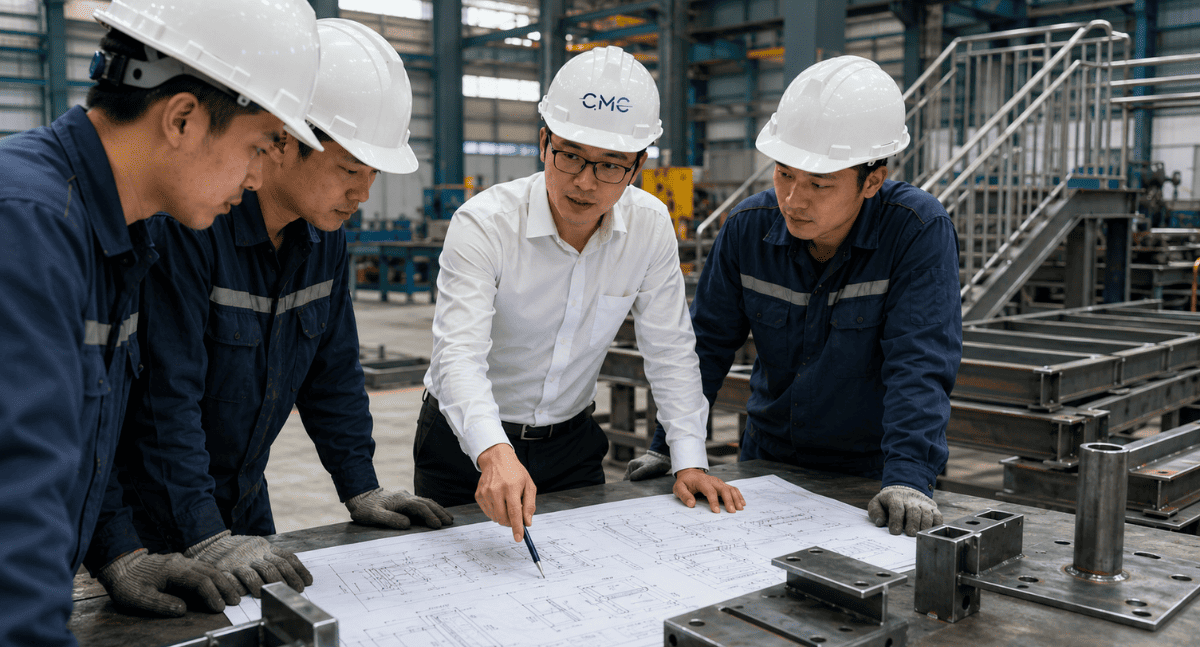
For steelwork items, connections are extremely important. A steel item may have a good shape and design, but if the connection is not strong, unsuitable, or unclear in terms of construction method, problems may still occur in reality.
Connection details that need clear technical notes include:
- Whether the connection is welded or bolted.
- Bolt type.
- Bolt diameter.
- Number of bolts.
- Bolt hole spacing.
- Base plate dimensions.
- Base plate thickness.
- Welding position.
- Weld length.
- Grinding, finishing, or concealed connection requirements.
- Connection to slab, wall, beam, steel column, or panel.
For example, in a steel railing drawing, if it is not clearly noted whether the base plate is installed on top of the slab or on the side of the slab, the fabrication team may place the bolt holes incorrectly. Once delivered to site, the detail may not match the actual installation position.
Therefore, technical notes for connections help ensure that the drawing is not only correct on paper, but also practical for fabrication and installation.
5. Technical Notes Help Fabrication Workshops Work More Accurately
Production drawings are documents used directly by the fabrication workshop. Workers, production supervisors, and quality control teams rely on drawings to cut materials, drill holes, weld, pre-assemble, treat surfaces, and inspect finished products.
If technical notes are unclear, the workshop may face problems such as:
- Not knowing which material to use.
- Not knowing which detail needs welding.
- Not knowing where holes need to be drilled.
- Not knowing whether the surface needs painting or galvanizing.
- Not knowing which detail should be fabricated first.
- Having no clear basis for checking the finished product.
A good production drawing should help readers understand quickly, correctly, and confidently without having to guess.
This is why steelwork drawings need to be presented clearly, with complete dimensions and specific technical notes.
6. Technical Notes Help Reduce Installation Errors on Site
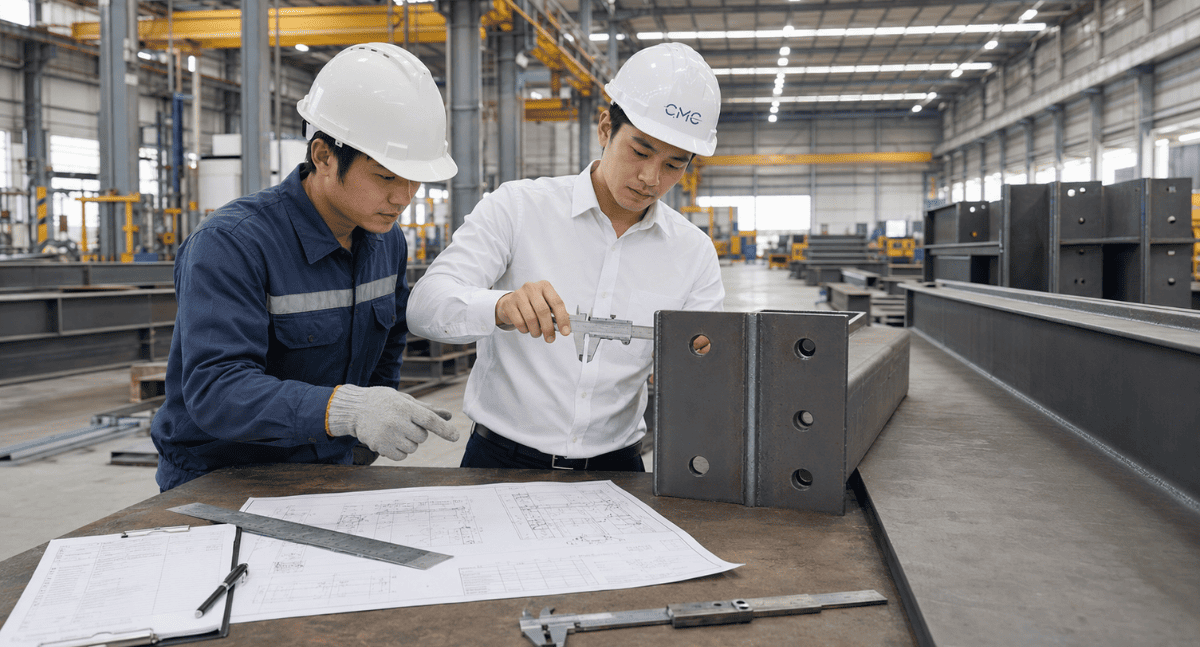
After fabrication, steelwork items are transported to the construction site for installation. If the production drawing does not clearly show technical instructions, the installation team may have difficulty checking and matching the item with actual site conditions.
For example:
- Details may not match the prepared hole positions.
- Base plates may be offset from the slab edge.
- Bolts may have the wrong diameter.
- Railing height may not meet the requirement.
- Handrails may not match the required level.
- Steel frames may conflict with walls, panels, or MEP systems.
- Finished surfaces may be scratched due to missing protection notes.
Clear technical notes help the installation team understand which points need to be checked before installation, what needs to be handled, and what should be noted to avoid deviations.
Especially in projects involving multiple parties, the clearer the technical notes are, the easier coordination becomes.
7. Technical Notes Help Control Surface Finish Quality
Surface finish directly affects both the appearance and durability of steelwork items. If the drawing does not clearly note the finish requirements, the product may have the correct shape but still fail to meet the expected performance or visual quality.
Common finish notes include:
- Powder coating.
- Anti-rust paint.
- Hot-dip galvanizing.
- Electro-galvanizing.
- Stainless steel hairline finish.
- Smooth grinding.
- Sharp edge treatment.
- End cap treatment.
- Weld concealment.
- Finish color.
- Surface protection during transportation.
For example, an outdoor railing needs clear notes about anti-rust treatment and surface protection suitable for the environment. A visible steel detail requires clear notes about grinding, weld treatment, and aesthetic finishing.
Without clear technical notes, the fabricated product may not meet expectations, even if the dimensions are correct.
8. Technical Notes Help Control Fabrication and Installation Tolerances
In steel fabrication, tolerances are extremely important. Not every detail can be fabricated and installed perfectly according to theoretical dimensions. Therefore, drawings should clearly state tolerance requirements when the project requires them.
Tolerance-related information may include:
- Overall dimensional tolerance.
- Drilling tolerance.
- Base plate position tolerance.
- Component length tolerance.
- Assembly tolerance.
- Allowable clearance.
- Installation gap.
- Positions that must be checked on site before mass production.
Tolerances help the fabrication workshop understand the required level of accuracy. They also give the quality control team a clear basis for inspection and acceptance.
For items such as steel door frames, panels, louvers, or steel staircases, tolerances must be carefully controlled to avoid installation mismatch on site.
9. Technical Notes Help Prevent Misunderstanding Between Different Parties
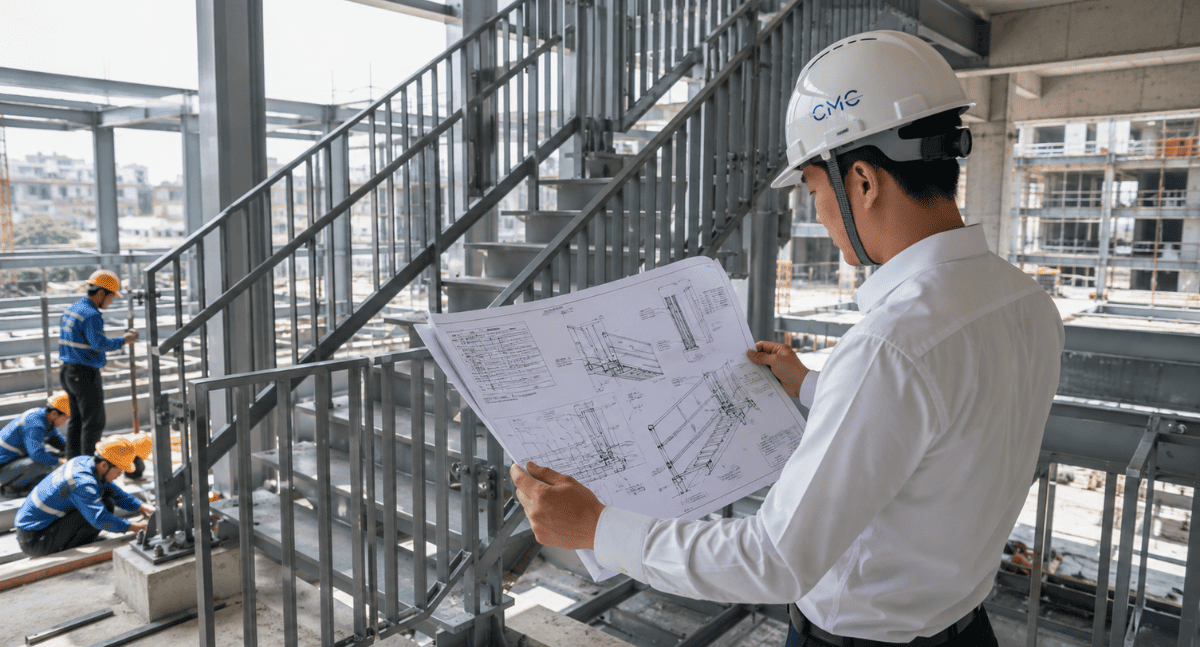
In a project, a drawing is not read by just one person. It may be used by designers, fabrication workshops, quality control teams, installation teams, project managers, clients, or overseas partners.
If technical notes are unclear, each party may interpret the drawing differently.
For example:
- The designer understands that welding should be done in the workshop, but the installation team assumes it should be done on site.
- The workshop understands that the item should be painted, but the client requires galvanizing.
- The drawing shows a base plate but does not specify its thickness.
- The bolt position is dimensioned, but the bolt type is not specified.
- A connection detail is shown, but the construction method is not clearly noted.
Clear technical notes help all parties share the same understanding. This is very important for reducing disputes, minimizing revisions, and improving project professionalism.
10. How Should Technical Notes Be Presented in AutoCAD 2D Drawings?
In AutoCAD 2D drawings, technical notes should be presented clearly, legibly, and without making the drawing layout confusing.
Some useful principles include:
- Use short and clear sentences.
- Avoid vague notes.
- Place notes close to the related detail.
- Use leaders or clear reference symbols.
- Keep font style and text size consistent.
- Do not place notes over dimension lines.
- Separate general notes from detail-specific notes.
- Review all notes before issuing the drawing.
- Make sure the notes match the material schedule and drawing details.
A good technical note does not need to be long. It needs to provide enough information for the reader to understand and execute correctly.
11. Technical Notes and Material Schedules Must Be Consistent
In steelwork production drawings, technical notes must be consistent with the material schedule. If the notes show one thing but the material schedule shows another, readers will not know which information is correct.
The following items should be checked for consistency:
- Material notes and material schedule.
- Steel specifications in details and in the material list.
- Component quantities in drawings and schedules.
- Base plate thickness in notes and details.
- Bolt type in notes and drawing symbols.
- Surface finish in notes and handover requirements.
Checking this consistency helps reduce mistakes in material ordering, fabrication, and product acceptance.
12. The Role of BIM in Checking Technical Notes
BIM does not completely replace AutoCAD 2D drawings, but it can effectively support overall information checking.
With BIM, the technical team can check:
- Installation positions of steelwork items.
- Space around connection details.
- Clashes with structural elements or MEP systems.
- The relationship between steelwork items and the building.
- Locations that need special notes on 2D drawings.
- Areas with a high risk of construction deviation.
When BIM is combined with AutoCAD 2D drawings, the design team can better identify which notes need to be added, which details need clarification, and which points need warnings before fabrication.
This helps the drawing package become both detailed and well coordinated within the overall project.
13. Common Mistakes When Technical Notes Are Not Clear
Some common mistakes in technical notes on steelwork production drawings include:
- Notes that are too general.
- Missing material information.
- Missing thickness information.
- Missing bolt type.
- Missing surface finish notes.
- Missing weld notes.
- Notes that do not match the drawing.
- Notes that do not match the material schedule.
- Notes placed in the wrong position.
- Too many notes without clear focus.
- Wording that can be misunderstood.
- Notes not updated after drawing revisions.
These mistakes can make the drawing look unprofessional, difficult to use, and more likely to cause errors in real production and installation.
Therefore, before handing over a drawing, the technical notes should be checked as carefully as dimensions and connection details.
14. How CMC Architects Vietnam Controls Technical Notes on Drawings

At CMC Architects Vietnam, we understand that a high-quality steelwork production drawing must not only have correct geometry and accurate dimensions, but also clear, complete, and easy-to-understand technical notes.
In our drawing development process, CMC Architects Vietnam focuses on:
- Reading and analyzing input information.
- Identifying steel materials and specifications.
- Checking base plates, bolts, and connection details.
- Clearly presenting fabrication notes.
- Clearly presenting surface finish requirements.
- Checking consistency between notes, dimensions, and material schedules.
- Using AutoCAD 2D to present drawings clearly.
- Using BIM to support overall checking when needed.
- Reviewing the drawing package before handover.
CMC Architects Vietnam supports drawing development for many steelwork and architectural metalwork items, including:
- Steel railings.
- Handrails.
- Steel staircases.
- Technical ladders.
- Steel door frames.
- Louvers.
- Panels.
- Base plates, bolts, and connection details.
- Other steelwork and architectural metalwork items.
Our goal is to create production drawing packages that are clear, easy to read, easy to fabricate, easy to inspect, and easy to install.
15. Conclusion
Technical notes are an important part of steelwork production drawings. If a drawing has dimensions but lacks clear technical notes, the fabrication workshop and installation team may still misunderstand the requirements or lack the necessary basis for accurate execution.
A professional production drawing package needs a combination of clear drawing views, complete dimensions, accurate connection details, and easy-to-understand technical notes.
Before issuing steelwork production drawings, ask yourself:
Have the materials been clearly noted?
Are the thickness and steel specifications complete?
Do base plates, bolts, and welds have clear notes?
Are surface finish requirements fully shown?
Do the notes match the drawings and material schedule?
Can the fabrication workshop read the drawing and proceed without guessing?
If the answer is “yes,” your drawing is much closer to a professional production document.
If you are looking for a team to support production drawings, AutoCAD 2D drawings, BIM, and shop drawings for steelwork and architectural metalwork items, contact CMC Architects Vietnam for consultation and project support.
CMC Architects Vietnam – Supporting you in creating clear, accurate, and professional steelwork production drawings.